
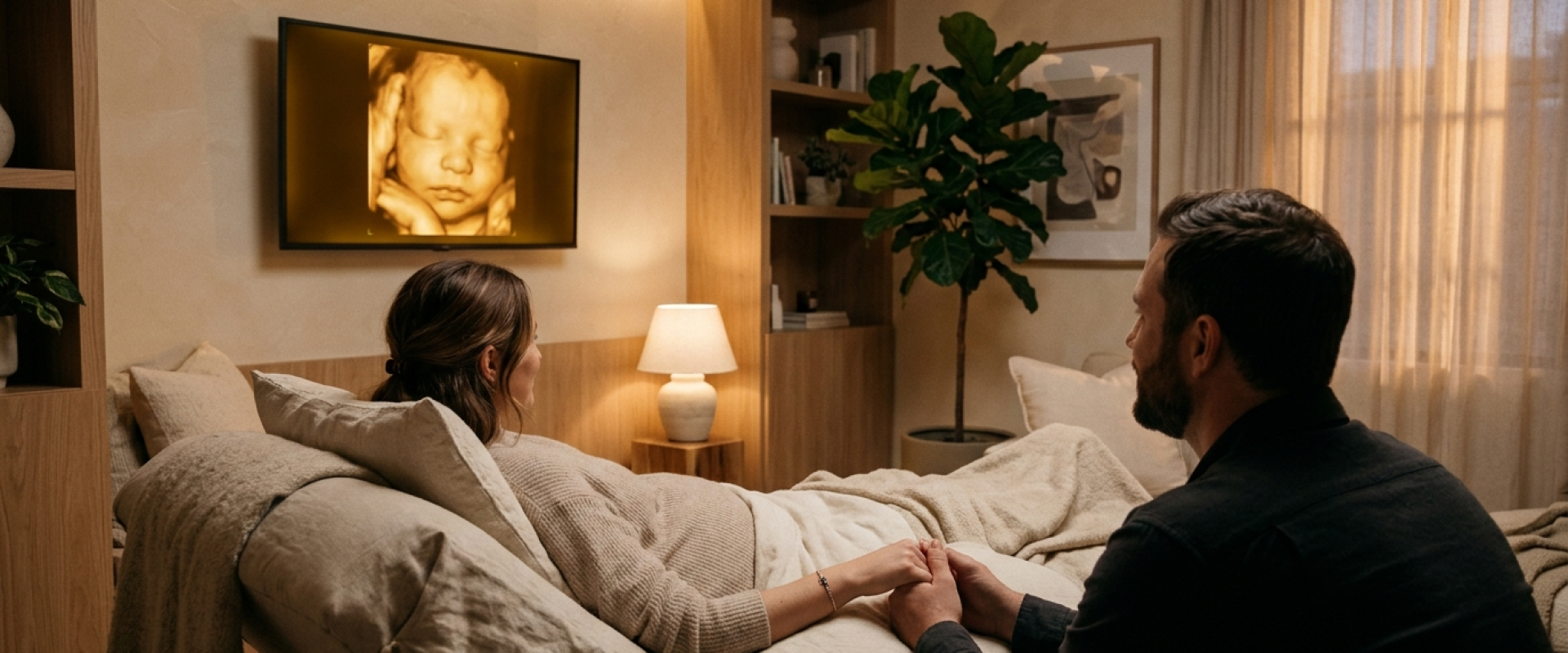
If you’re deciding when to book a 3D keepsake scan, the answer is usually the late second trimester into the early third, once your baby has enough soft tissue to show a rounded face and there’s still room to move. At our Menai NSW clinic, we talk with expectant parents every week about timing, and the honest answer is that gestational age is only part of the picture. Your baby’s position, the fluid around them and where your placenta sits all shape the portrait on the day.
Key Takeaways
- Many families book a 3D scan in the late second or early third trimester, when facial features look fuller and there’s usually still some fluid for the sonographer to image through.
- Gestational age, baby’s position, amniotic fluid and placental placement all affect a still 3D surface image, and no clinic can guarantee a particular view.
- A keepsake 3D scan is non-diagnostic and needs no referral. It doesn’t replace the medical care and checks arranged by your GP or specialist.
- Booking a little flexibility into your plans, and asking us about timing, gives you the best chance of a lovely set of images.
3D Ultrasound in Pregnancy: When Is the Best Time to Book?
At UBM Scans in Menai NSW, the most common question we hear is “what is the best time for a 3D ultrasound?” The widely shared rule of thumb is the window from the late second trimester into the early third, often described as somewhere around 26 to 32 weeks. It’s a guide rather than a rule, and it’s worth asking us about your own dates when you book.
The reasoning is simple. Earlier than that, your baby is still quite lean, and the surface of the face has less of the soft fullness that makes a 3D portrait feel so lifelike. Much later, there’s less fluid and less space, and your baby may be snuggled deep into your pelvis with a hand or the uterine wall close to their face. Between those two points, many babies have a pleasing balance of detail and room to move.
That said, a window is not a promise. Some babies are camera-shy at 28 weeks and obliging at 31. Others show a full face in the first minute. If you’d like a longer read on the differences between scan types, our guide to 2D, 3D and 4D ultrasound explains how each one works.
How Gestational Age Shapes Your Baby’s Portrait
A 3D image is built from the surface of what the ultrasound can “see” in front of it, which means it is essentially a still sculpture of the skin and features closest to the probe. That’s why gestational age matters so much for a keepsake scan.
In the second trimester, features are forming and growing. By the late second trimester, many parents can see a recognisable profile, a nose, lips and the shape of the brow. As the weeks pass into the third trimester, babies typically gain more soft tissue, and cheeks and lips can look rounder in a 3D surface image. Many parents find this is the stage where the portrait starts to look like a real newborn photograph, though what you see on the day varies from baby to baby.
It’s also worth remembering that “best” depends on what you want from the session. If you’re hoping for a face portrait, the later part of the window may suit. If you’d like a more relaxed schedule, or you expect to be busy around the end of your pregnancy, booking earlier within the window can give you breathing room for a second attempt if your baby isn’t cooperating.
It can help to think of 3D ultrasound in pregnancy as a window of weeks rather than a single perfect date. Within that window, the same baby can look quite different from one week to the next, because growth, fluid and position are all shifting. Choosing a week that suits your schedule, and leaving a little room to reschedule if you’d like another go, often takes the pressure off the day itself.
For families who are very early in pregnancy and simply want a moment of comfort, a different service may suit better. Our guide to reassurance scans explains what an early keepsake scan offers, and it’s separate from the 3D face-portrait window described here.
Baby’s Position: The Biggest Variable on the Day
If gestational age sets the stage, position decides whether the performance goes ahead. For a clear face view, your baby generally needs to be facing towards the front of your tummy, with the face visible and not pressed against the placenta, the uterine wall or your baby’s own hands, arms or umbilical cord.
Babies move through the session, and a sonographer can’t tell them where to look. Some of the things that commonly influence the view include:
- Facing your back. If your baby is curled towards your spine, the probe is looking at the back of the head, which doesn’t make a flattering portrait.
- Hands and arms near the face. Many babies hold their hands up, which is adorable but can partly hide features.
- Head position deep in the pelvis. Later in pregnancy, a head sitting low can make it harder to get a clear angle.
- The umbilical cord. Occasionally, a loop of cord lies across the face.
Our sonographers are experienced, with more than 15 years of medical-imaging experience, and they can often encourage a better view with gentle patience, a change in your position or a short break. Still, the baby has the final say. If you’d like to know how best to prepare, our tips on getting clear images during a 4D ultrasound apply just as well to a 3D session.
A 3D portrait is a conversation between your baby, your body and the day, and the best images come when we let all three have a say.
Amniotic Fluid: The Window Your Baby Floats In
Amniotic fluid is a quiet hero of 3D imaging. Ultrasound waves travel well through fluid, and the pocket of fluid in front of your baby’s face gives the machine a clear space to draw the surface of the skin. Where there’s a good amount of fluid between the face and the nearest surface, the image can show more definition.
As pregnancy moves into the third trimester, babies take up more space, so there is naturally less room around them. This is one of the reasons the later part of the pregnancy can feel more challenging for a face portrait, even though the baby looks fuller. The amount of fluid varies from pregnancy to pregnancy, and it isn’t something you can control or reliably predict, so we can’t say in advance how it will look on your scan day.
A keepsake scan isn’t designed to assess fluid levels or any aspect of your baby’s health. If you have any questions or concerns about the amount of fluid or your baby’s wellbeing, your GP or specialist is the right person to ask.
Placental Placement: Front, Back or Somewhere In Between
Where your placenta sits can influence the view too. A placenta on the front wall of the uterus, between the probe and your baby, can sit in the way of the ultrasound beam. Because the placenta is thick tissue, it can reduce the clarity of the image when it lies directly in front of the face. A placenta along the back or side wall tends to leave the front clear for the probe.
Placental position is simply part of how each pregnancy is. It’s not something to worry about, and it doesn’t say anything about how your pregnancy is going. It does mean that two parents at the same gestational age can have noticeably different keepsake sessions.
Other factors, such as the thickness of the tummy wall, can also have an effect on how well the ultrasound passes through. None of these are things you’ve done wrong, and none of them are fixable by trying harder. Knowing about them in advance simply helps you set relaxed expectations. Our article on what can and can’t be seen in a 3D/4D ultrasound goes into more detail about the limits of surface imaging.
Ready to Talk Timing?
If you’re unsure which week suits you, we’re happy to talk it through. Our Menai clinic is open Monday to Thursday from 6:30pm to 8:30pm and Saturday from 8:00am to 12:00pm.
What a Keepsake 3D Scan Is, and What It Isn’t
It helps to be clear about what you’re booking. A 3D ultrasound in pregnancy at UBM Scans is an elective keepsake experience. It’s an opportunity to meet your baby’s face, share the moment with family, and take home images to treasure. It is not a diagnostic scan, and we don’t interpret findings, diagnose conditions or comment on how your baby is developing.
No referral is required for our keepsake services, including 3D and 4D scans, so you can book directly. Our keepsake scans are privately paid. For current pricing, please contact us, because it can change and we’d rather give you an up-to-date answer than an out-of-date one.
Diagnostic ultrasound is a separate arm of our work, performed only with a valid referral from your GP or specialist. If you have symptoms, worries about your pregnancy or any question about your baby’s health, please speak to your GP or specialist first. If something feels urgent, such as severe pain or sudden changes, seek medical help rather than booking a keepsake appointment.
Planning Your 3D Baby Ultrasound in Sydney
Our main clinic is at 10 Anzac Rd, Menai NSW 2234, which serves families across the Sutherland Shire and wider Sydney. We also have a second location at Macarthur Square, Campbelltown NSW 2560, which operates on Saturdays by appointment at the moment. If you’re searching for a 3D ultrasound in Campbelltown, please check availability with us when you book, as arrangements can change. National Centre for Immunisation Research and Surveillance (NCIRS)’s guidance on influenza vaccination during pregnancy: coverage rates and influencing factors in two urban districts in Sydney | NCIRS sets this out in more detail.
All of our scans are performed in clinic. A few practical ideas can help your session go well:
- Choose a date within your preferred window, and keep a little flexibility if you can.
- Drink water as you normally would in the days beforehand, and ask us if you’d like specific preparation advice.
- Bring the people you’d like to share the moment with, and tell us when you book if you have any particular needs.
- Go in with open expectations. We’ll always do our best, but we can’t promise baby’s position or a specific image.
If you’d like a fuller walk-through of what to expect, everything to know before your 3D ultrasound in Sydney covers the session from arrival to take-home images.
Frequently Asked Questions
What is the best week for a 3D baby ultrasound?
Many families aim for the late second trimester into the early third, often cited as around 26 to 32 weeks. Every pregnancy is different, so please ask us about your own dates when you book. We can’t guarantee a particular view at any week.
Can you guarantee a clear picture of my baby’s face?
No. Baby’s position, the fluid around them, the placenta’s location and other factors all influence the image. Our sonographers do their best on the day, and sometimes a short break or a change in your position helps, but we can’t promise a specific image.
Do I need a referral for a 3D scan?
No. Keepsake 3D and 4D scans don’t require a referral from your GP or specialist. Diagnostic ultrasound is different and always needs a valid referral.
How much is a 3D ultrasound for a baby?
The cost depends on the type of scan and what you choose, and pricing can change over time. Please contact UBM Scans for current pricing so you get an up-to-date answer. Keepsake scans are privately paid.
Is a 3D scan the same as a medical pregnancy scan?
No. A keepsake 3D scan is elective and non-diagnostic. It isn’t a substitute for the scans and care arranged by your GP or specialist, and we don’t interpret results or diagnose conditions. Speak to your treating clinician with any health questions.
Where can I book a 3D baby ultrasound near me?
We have a clinic in Menai and a second location in Campbelltown, which currently runs on Saturdays by appointment. Contact us and we’ll help you find a time that suits.
Choosing Your Moment to Meet Your Baby’s Face
Picking a week for your 3D ultrasound in pregnancy is really about balancing a few things: a baby with enough soft tissue to show beautiful features, enough room for them to move, and a date that suits your family. The late second to early third trimester is a popular window for a 3D ultrasound in pregnancy for good reason, but it isn’t a guarantee.
Position, fluid and placenta placement are part of what makes each pregnancy unique, and they’re also part of what makes each portrait unique. Going in relaxed, with realistic hopes and a little flexibility, is the best way to enjoy the experience, whatever the images turn out to be.
We’d love to help you plan the moment, and to answer any questions about timing along the way.
Ready to book your 3D scan, or want to ask about timing first?